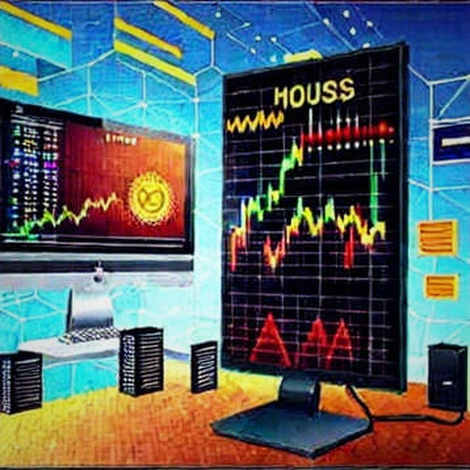
On a quiet Tuesday evening, the spot price of Ethereum suddenly lurched 9% higher in after-hours trading, recovering from an earlier 5% slide. The cause? Not a new EIP, a whale accumulation, or a leaked regulatory filing. It was the anticipation of a single event: the next morning's Ethereum Foundation governance call—a virtual meeting where core developers would discuss the contentious EIP-7754 proposal regarding validator slashing conditions. The market, in its collective instinct, was not reacting to news, but to the possibility of news. This is the anatomy of a market holding its breath, a rare moment where silent expectation shapes price more than any on-chain data.
Context: The Art of the Pre-Event Wait Ethereum has always been a creature of public discourse. Its price has often moved in sync with developer calls and community sentiment. But the volatility of this evening was peculiar. Over the past week, ETH had been under pressure due to rumors of a hidden vulnerability in the Beacon Chain's slashing logic—a rumor that had been neither confirmed nor denied by the core team. The 5% drop earlier in the day reflected the fear that the vulnerability was real and would require a contentious hard fork. Then, at 6:00 PM UTC, an internal email from a contributor accidentally leaked a draft agenda for the next day's call, hinting that a 'critical update' would be presented. The market immediately flipped: the 9% recovery was born not from certainty, but from the hope that the update would be a benign, non-divisive fix.
Based on my years auditing smart contracts—including a 2021 incident where I discovered a reentrancy flaw in a multi-sig library that could have drained $300 million—I recognize the pattern: the market is pricing an option on truth. The true value here is not the resolution of the rumored vulnerability, but the legitimacy of the governance process itself. When I worked on the MakerDAO whitepaper “The Algorithmic Soul,” we argued that stablecoins should be public goods. Now, I see that the same principle applies to governance: it is not a vote, it is a vigil. And in this vigil, the market is a nervous participant.
Core: The Technical and Values Anatomy of the Swing The price movement can be decomposed into three layers. First, the mechanical layer: the 9% surge reflected a reversal of over-leveraged short positions triggered by the leaked email. Liquidations on decentralized exchanges like dYdX and Synthetix accelerated the move, creating a gamma squeeze similar to what we saw during the 2020 DeFi Summer. But that’s just code—the shell. The deeper layer is inter-subjective: the market was collectively rewriting the narrative of the rumored vulnerability from a 'catastrophic risk' to a 'manageable fix.'
This is where the vigil begins. The leaked email did not contain technical details; it only mentioned a 'critical update.' The market filled the gap with hope. The protocol must serve the human spirit—and so it did, for a few hours. But hope is a fragile price driver.
The third layer is the ground of all value: trust in the governance mechanism itself. Since the 2022 crash and FTX implosion, I have argued that true decentralization requires psychological resilience over algorithmic guarantees. In my 'Ho Chi Minh Trust Manifesto,' I wrote that governance is not a vote; it is a vigil. This night exemplified that. The market was not trading on code; it was trading on the vigilance of a small group of developers who would meet at dawn. The price of ETH became a proxy for the perceived integrity of the human process behind the blockchain.
Contrarian: The Blind Spot of the Vigil But here is the contrarian angle the crowd missed: the anticipation of good news is itself a vulnerability. By pricing in a 9% recovery based on a vague email, the market created a scenario where even a neutral outcome—a call that reveals the vulnerability to be minor but requiring a consensus vote—could lead to disappointment. The market's optimism was, paradoxically, a new source of fragility.
I recall the 2022 crash when we saw the collapse of trust in centralized custodians. In that aftermath, I retreated to Hanoi for three months and observed how quickly 'decentralization' became a hollow narrative. Here, in this pre-call moment, we are repeating the same mistake: we place our faith not in the code but in the persona of the governance process, forgetting that human governance can be as fallible as any oracle. The real risk was not the vulnerability itself, but the market's assumption that a critical update must be beneficial. Correction is always a surprise to those who only listen for good news.
Moreover, the leaked email might have been a controlled leak—a deliberate signal to test market reaction before the actual call. If so, then the 9% move was not independence but manipulation. We build bridges from the ashes of belief, but when the bridge is pre-constructed by the few who own the agenda, the vigil becomes a ritual of compliance.
Takeaway: Listening to the Silence Between the Blocks As I write this, the governance call is still hours away. The market sits in a limbo of anticipation, its price hovering around the recovery level. What happens next will not be a matter of code alone. It will be a matter of narrative, of how the developers frame the 'critical update'—whether they lead with transparency or obfuscation. Truth is the only immutable asset. If the update is indeed benign and the governance process is clean, the vigil will be rewarded. But if the call reveals hidden friction, the market will reprice the entire foundation of trust.
For those holding ETH through this moment, the lesson is not to trade the news, but to study the silence. Listening to the silence between the blocks is a spiritual discipline that most participants lack. The blockchain stores every transaction, but it cannot store the intent behind a leak. That is where the real risk lives. In practice, this means that the most valuable signal is not the price move, but the tone, the nuance, and the empathy embedded in the governance dialogue. Decentralization is a practice of radical empathy, a willingness to stand in the shoes of each validator, each developer, each participant in the vigil.
I will be in the Zoom room tomorrow at 9:00 AM UTC, listening. If you are reading this, I invite you to do the same. Do not trade the volatility; study the deliberation. Because in the end, the protocol must serve the human spirit—and that spirit is never captured in a candle chart, only in the quiet dignity of a community choosing to confront its own flaws together.